
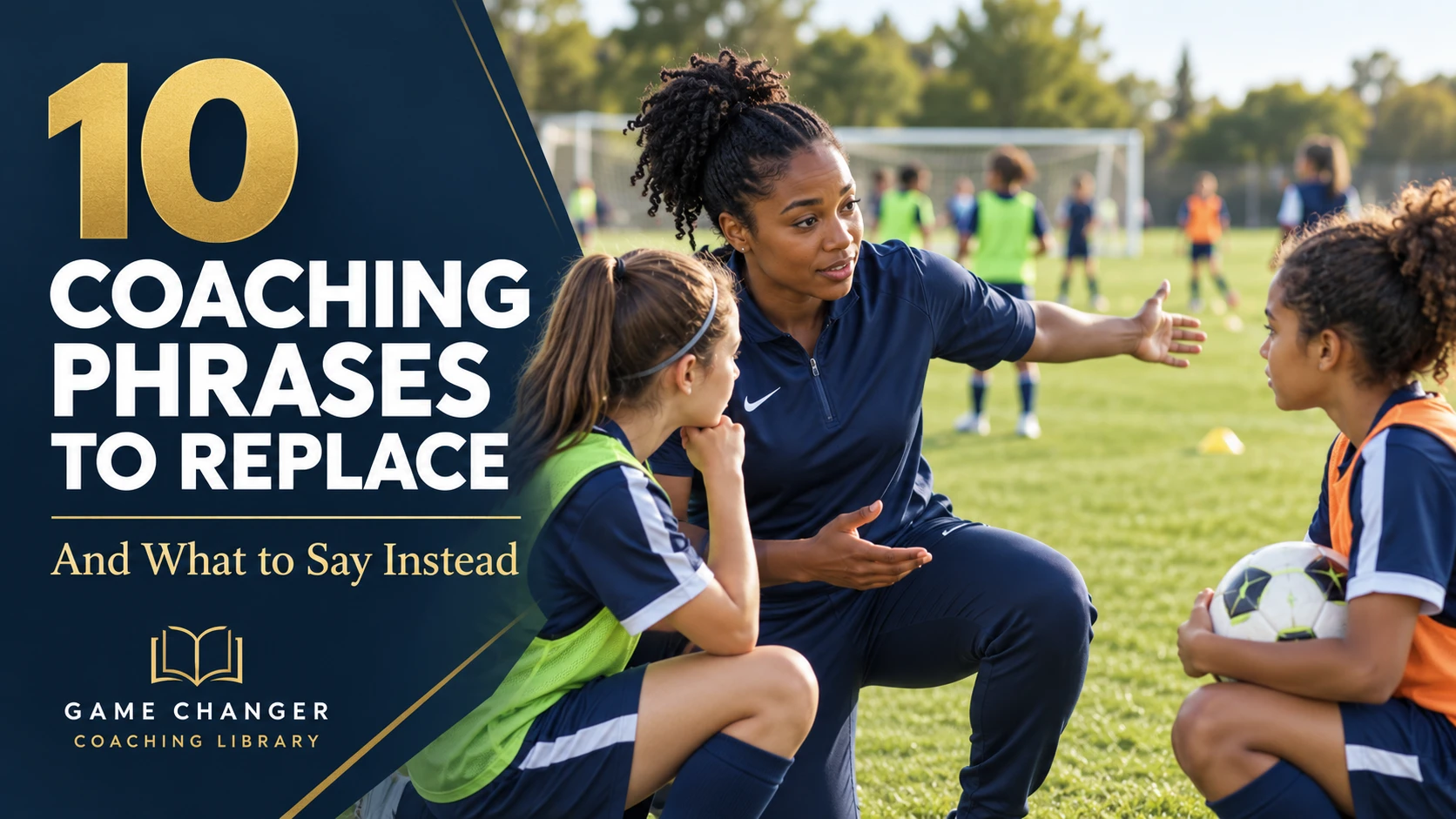
A player loses possession. The coach shouts, “Wake up!”
Another player receives under pressure. “Play quicker!”
A third player misses a chance. “You have to score that!”
These reactions are familiar on football grounds. They may express what the coach feels, but they often leave the player wondering what to do differently.
For a young coach, improving your language is a practical way to improve your coaching. You do not need new equipment or a larger collection of exercises. You need to notice the football situation and give information the player can use.
The aim is not to replace every instruction with a question. Players sometimes need a clear direction or demonstration. At other times, a question helps you understand what they saw and how they reached a decision.
What matters is whether your words help the player recognise the problem and respond to it.
The alternatives below are examples to adapt, not scripts to repeat regardless of the situation. Use one useful message at a time, then allow the player to play.
1. Replace “Wake up!” with “What did you notice before the pass arrived?”
The situation: A player receives without recognising pressure and loses the ball.
“Wake up!” assumes that the problem is attention or effort. The player may have been concentrating on the ball while missing the defender behind them. They may also have lacked a usable supporting option.
Ask what the player noticed. Listen before explaining what you observed. If information gathering was the difficulty, offer a clear next action: “Check where the pressure is before the pass arrives.”
Make the check purposeful. A shoulder movement alone does not show that the player understood what was available.
Reflection: Did I establish what the player saw before deciding why the action failed?
2. Replace “Move!” with “Can you change your angle so your teammate can find you?”
The situation: A supporting player stands behind a defender and offers no accessible passing lane.
Movement is useful when it changes the football problem. Running closer to the ball may bring another defender into the same space. Moving away, across or behind may provide a better option.
Point out the blocked relationship: “The defender is between you and the ball.” Then invite the player to find an angle the passer can use.
With younger players, demonstrate two positions and let them compare which makes the pass easier. Return to the game so they can adjust as the defender moves.
Reflection: Did my instruction explain the purpose of the movement?
3. Replace “Play quicker!” with “What can you prepare before receiving?”
The situation: A player takes several touches while an opponent closes down.
Quicker play does not always mean fewer touches. The player may need earlier information, better body positioning, a clearer first touch or support from a teammate. In another situation, holding the ball may help attract pressure and release someone else.
Ask what could be prepared before the ball arrives. If a first-time option is available, help the player recognise it. If it is not, coach the action that creates time or protects possession.
Avoid making speed the only standard. A rushed pass into a closed lane can be less useful than a controlled action that preserves an opportunity.
Reflection: Was the player slow to execute, late to recognise the situation, or short of options?
4. Replace “Don’t lose it!” with “Where is your safest useful option?”
The situation: A player receives with pressure approaching and the coach anticipates a turnover.
“Don’t lose it!” identifies an unwanted outcome without offering a solution. It can also discourage a player from attempting an appropriate forward action.
Help the player assess the actual options. Can they protect the ball, combine, turn into space or return it to support? The safest useful option may change as a defender commits.
Use a brief direct cue when an immediate threat requires it: “Pressure behind—protect it.” Later, ask what the player saw and discuss an alternative. Avoid turning every reception into a command to pass backwards.
Reflection: Did I help the player solve the pressure, or only warn them about failure?
5. Replace “You have to score that!” with “What could help your next finish?”
The situation: A player misses from a promising position.
The player usually knows the chance was good. Repeating that fact rarely clarifies the adjustment they need.
Examine the moment. Was the player balanced? Was the ball travelling awkwardly? Where were the goalkeeper and defender? Did the player select a reasonable finish but execute it poorly?
Choose one relevant cue, such as “Set yourself before contact,” if balance was the issue. Where another option existed, ask what the player noticed. Then provide a realistic opportunity to try again with pressure and a goalkeeper where appropriate.
Reflection: Did my response identify a coachable action, or simply express disappointment?
6. Replace “Stop being selfish!” with “What other option was available, and when?”
The situation: A player dribbles into pressure while a teammate appears free.
“Selfish” assigns a motive. The player may not have seen the teammate, may have believed the passing lane was blocked, or may have recognised a reasonable dribbling opportunity that closed quickly.
Ask about the available information before judging the choice. Identify when the pass could have been played and what happened to the lane. Also examine the teammate’s support.
If the player did recognise a better option and ignored it, discuss the decision directly. You can challenge an action without defining the player’s character. Keep dribbling available when it solves the situation.
Reflection: Am I coaching a decision, or making an assumption about the player’s intentions?
7. Replace “Be more aggressive!” with “Close the space and make the next pass difficult.”
The situation: A defender allows an opponent time to advance.
“Aggressive” can mean different things to different players. One may rush into a tackle; another may increase physical contact when the real need is a better approach angle.
Describe the action the situation requires. That may mean closing space under control, blocking an inside pass, delaying the attack or recovering with teammates. “Show them toward the touchline” can help when that direction fits your defensive plan and covering support.
Demonstrate how to approach without being easily beaten. When pressing is unsuitable, explain the recovery responsibility. More effort alone will not repair poor defensive relationships.
Reflection: Did I specify what effective defending looks like in this moment?
8. Replace “Keep your shape!” with “Who is providing width, support and cover?”
The situation: Several players move toward the ball and the team loses its connections.
A formation diagram does not tell players how to respond as the ball, opponents and teammates move. They need to understand which functions are missing.
Ask about one relevant relationship rather than listing every positional error. If width has disappeared, help a player create an outside option. If the team is exposed behind the ball, identify who needs to provide cover.
Players can exchange positions while preserving those functions. For younger groups, use concrete language: “Can someone give us an option on the other side?” Add tactical detail as understanding develops.
Reflection: Was I asking players to restore a useful relationship or merely return to a starting position?
9. Replace “Good job!” as your only feedback with “Your movement opened the passing lane.”
The situation: A player makes a useful supporting run that helps the team progress.
Encouragement matters, and “Good job!” does not need to disappear. But specific feedback helps players recognise what was useful.
Describe the action and its effect: “You moved away from the marker, which gave your teammate a forward option.” Recognise sensible choices and helpful support as well as goals or successful passes.
Do not invent praise or make every positive action a public announcement. A short individual comment can be enough. You can also ask, “What did your movement make possible?” and hear whether the player understands the relationship.
Reflection: Does my praise help the player identify something worth repeating?
10. Replace “I’ve told you already!” with “Show me how you understand it.”
The situation: A player repeats an action the coach has previously corrected.
Hearing an explanation does not guarantee that the player understood it or can apply it under pressure. The instruction may have been too long, the task too difficult or the relevant cue unclear.
Ask for a demonstration. Let the player explain where they would move or what they would look for. Check the gap between your intended message and their understanding.
If understanding is clear but application remains difficult, adjust the challenge and provide another opportunity. Repeated difficulty is a reason to investigate your teaching as well as the player’s response.
Reflection: Have I checked understanding, or only repeated the instruction?
Better language begins with better listening
A useful question loses its value when the coach interrupts the answer or accepts only their preferred wording.
Allow thinking time. Hear the explanation. Paraphrase it: “You thought the defender was going to follow you inside—is that right?” Then compare that account with what happened.
You do not have to agree with every interpretation. You do need to understand it before deciding what information will help. A player who finds speaking difficult may demonstrate, point to the pitch or discuss the moment with a partner.
The conversation should lead back to football. Agree one action to test, restart play and look for the next relevant opportunity.
Try changing two phrases this week
Choose two phrases you use frequently. Write down the situations in which you tend to say them and prepare a more useful alternative.
During your next session, notice your response without trying to perfect every conversation. Afterwards, ask:
- Was my message clear and appropriate to the moment?
- Did I listen when I asked a question?
- What did the player try next?
- What will I change in the following session?
The measure of useful coaching language is what it helps players notice, understand and attempt. Your next sentence can give a young footballer a clearer way forward.
For further development, The Developing Coach: Building Your Coaching Identity explores how values become everyday coaching behaviours. Designing Reflective Practices supports observation, player conversations and follow-up review.
Further reading
England Football Learning, How coaches can communicate effectively.
FIFA Training Centre, When to tell and when to ask.
The phrase alternatives and football examples above are practical suggestions by the author, to be adapted to the player and situation.