
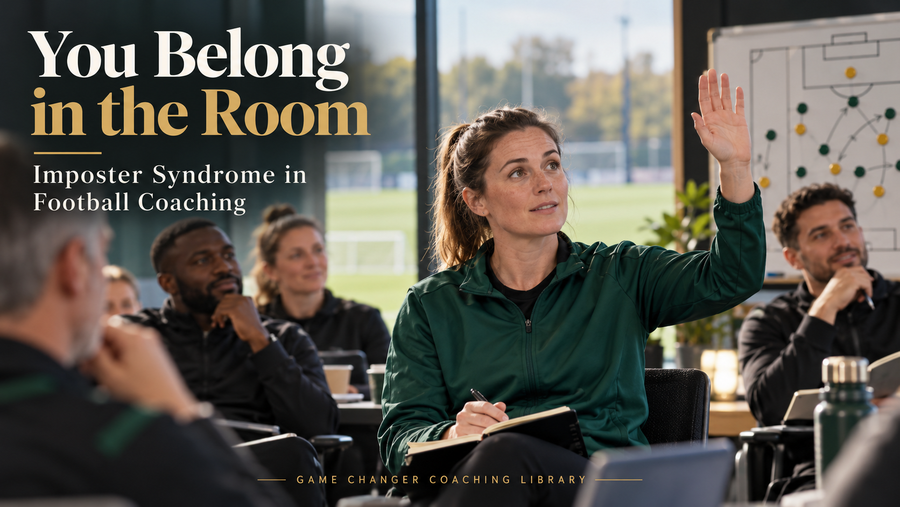
A coach arrives at a workshop with a notebook, experience and a genuine desire to improve. Around the room, participants mention professional clubs, advanced qualifications and international tournaments. The tutor introduces a tactical concept using unfamiliar terminology.
The coach has a useful question but decides against asking it.
“Everyone else probably understands. If I speak, they will realize I do not belong here.”
The session continues. The question remains unanswered. A learning opportunity has become an exercise in avoiding exposure.
For some football coaches, this is familiar. They can organize training, support players and make sound decisions, yet feel fraudulent when entering a room with more visibly successful colleagues. Coach development depends on participation: asking questions, testing ideas, accepting feedback and discussing uncertainty. Fear can restrict all four.
What are imposter feelings?
Often called imposter syndrome, the imposter phenomenon describes difficulty internalizing achievement alongside fears of being exposed as less capable than others believe. A coach may credit success to luck or a talented squad while interpreting every mistake as proof of personal inadequacy.
It is not a formal clinical diagnosis. Ordinary nerves, unfamiliar terminology or a genuine skill gap do not automatically indicate imposter feelings. A coach can need further learning without being a fraud.
A systematic review by Bravata and colleagues found associations between imposter experiences and difficulties including anxiety, burnout and reduced job satisfaction across professional populations [1]. Those findings do not establish football-specific prevalence or prove that these feelings cause every coaching difficulty.
The football examples here are illustrative applications, intended to support reflection rather than diagnose a colleague.
Humility should invite learning
Healthy humility says: “I have experience, and there is more for me to learn.” Imposter thinking can say: “If I need to learn this, my experience must be worthless.”
Accurate self-assessment identifies a specific need: “I need to improve how I analyze an opponent’s press.” A global judgment—“I am not a proper coach”—offers no usable development target.
Separate the task from your identity. A weakness in one area does not erase competence in another. Equally, confidence does not remove the need to demonstrate sound coaching. The goal is an honest account of your strengths, limitations and next steps.
Coaching courses: when assessment becomes exposure
Courses often ask coaches to deliver a practice while tutors and peers observe, then explain their decisions. That exposure can encourage preparation. It can also shift attention away from the players and toward managing impressions.
A coach may choose an elaborate activity to look advanced, use terminology they cannot clearly explain or avoid adapting the session because changing the plan might appear uncertain. Another may rehearse every sentence while leaving little capacity to respond to players.
Imagine a tutor saying: “Your stopping point interrupted a useful player solution.” The coach hears: “You are not good enough to be here.”
The useful response is narrower. What were the players doing? Why did the coach stop them? Would an individual correction or later review have helped more? What should they test next?
Assessment standards remain important. Clear criteria and specific evidence help distinguish a development need from a sweeping personal judgment. A course is valuable because it creates opportunities to examine decisions, including decisions that need improvement.
Workshops: silence does not prove understanding
A quiet participant may be reflective, unfamiliar with the language, tired or prefer listening. Educators should not assume silence means insecurity—or comprehension.
However, fear of appearing uninformed can lead a coach to withhold questions, avoid demonstrations or allow a confident colleague to dominate a group task. They may return to familiar routines because testing a new idea feels less safe.
Offer several ways to contribute: paired discussion, written questions, small-group planning and practical observation. A participant who struggles to speak to the whole room might first explain an observation to a partner.
For the coach, choose one manageable contribution. Ask what a term means in a game. Describe something the players did. Offer one adaptation to a practice. Participation does not require the longest speech or the most sophisticated vocabulary.
Conversations with elite coaches
An elite coach’s experience deserves respect. It does not make every method directly transferable to your environment.
A professional club may have analysts, specialist staff, daily contact time and excellent facilities. A youth coach may have two weekly sessions, mixed experience levels and limited equipment. The principle might transfer; the delivery may require adaptation.
Imposter feelings can make a coach surrender their judgment: “If this coach does it, I must copy it.” Another response is withdrawal: “My programme is too small to contribute.” Both can restrict learning.
Describe the football problem clearly: “My U15 players support after a regain but occupy the same passing lane. How would you help them recognize distinct angles?”
Ask what information guides the coach’s decision, what alternatives they considered and what they would change with fewer resources. Seek reasoning you can examine, rather than instructions to imitate.
You do not need to match someone’s résumé to ask a thoughtful question. Your context can reveal a practical challenge a well-resourced environment rarely encounters.
How confidence and development can be affected
Fear of exposure can reduce participation. A coach avoids applying for a course, requesting observation or contributing to staff planning. Fewer attempts mean fewer opportunities for useful feedback.
Positive evidence may also be discounted. Players improve, but the coach credits only talent. A tutor recognizes effective questioning, but the coach assumes they are being kind. Mistakes remain visible while progress disappears from the internal record.
Some coaches may become excessively cautious. They choose familiar practices rather than testing a useful change, or imitate an impressive session instead of defending a simpler design suited to their players.
Others may become defensive. If feedback feels like exposure, it can be difficult to distinguish a valid disagreement from self-protection. The coach hears a criticism of their worth rather than a discussion of an intervention.
These are possible patterns, not a diagnostic checklist. They can create a cycle: fear limits participation; limited participation reduces feedback and evidence; uncertainty remains unresolved; the next learning opportunity feels equally threatening.
Examine the environment as well as the individual
Not every feeling of exclusion is an inaccurate private belief. Ridicule, dismissive tutors, opaque assessment or discrimination can make a learning environment genuinely difficult. Telling a coach to “be more confident” does not address those conditions.
Women in predominantly male coaching spaces, coaches working in a second language and colleagues from less visible programmes may encounter assumptions about their credibility. This does not mean any group inevitably experiences imposter feelings. It means organizers should examine whose contributions receive attention and whose experiences are dismissed.
Ask whether club affiliations are being treated as proof of insight. Notice who gets interrupted. Explain assessment criteria. Challenge weak reasoning respectfully, regardless of the speaker’s status.
Inclusion does not require lowering professional standards. A tutor can challenge an explanation without humiliating the person offering it.
Prepare to learn rather than to appear complete
Before your next course, identify one strength supported by evidence, one genuine development need and two questions connected to your players.
For example: “I can organize an engaging small-sided game. I need to improve when I intervene. I want to understand how tutors distinguish an individual correction from a group stoppage.”
During the workshop, choose one achievable contribution. Avoid measuring success only by whether you felt confident. Asking a useful question can be worthwhile even while nerves remain.
Useful phrases include:
- “Could you show what that term looks like in a game?”
- “My interpretation is this. What am I missing?”
- “Would that principle change with a younger group?”
- “I have not worked at that level. In my environment, this is the challenge.”
Afterward, record one contribution that helped, one unclear point and one action to test. Keep a simple evidence record: task, observation, feedback and next step. Include limitations as well as strengths. The aim is accurate confidence rather than a collection of compliments.
Request feedback you can use
“Was I good?” invites a broad judgment. “Did my intervention help the players recognize the spare teammate?” invites analysis.
Ask a tutor or mentor to observe a specific feature: instruction length, question quality, player response or adaptation of the activity. Discuss what happened and agree a realistic next experiment.
FIFA’s student-coach mentoring guidance emphasizes a positive learning environment, active participation in the debrief and reflection supported by instructional guidance [2]. Applied here, the coach examines decisions without treating uncertainty as a personal failure.
A mentor should avoid relying on endless reassurance. Specific evidence and honest feedback help build judgment; repeated “you are brilliant” statements may leave the practical question unanswered.
The responsibility of educators and elite coaches
State the purpose and criteria before the task. Explain where experimentation is welcome and which standards are fixed.
Use observable feedback: “Three players did not understand the restart” rather than “You lack authority.” Explore the explanation, then let the coach try a clearer instruction.
Share an appropriate example of your own learning or revision. Expertise includes recognizing when an interpretation needs changing.
Invite examples from different contexts and allow thinking time. Do not equate polished speech with deep understanding. Ask participants to connect an idea to a player action and explain how they would test it.
When coaches disagree, examine evidence and assumptions. A less experienced coach may identify something useful; a more experienced coach may offer a sound correction. Neither contribution should depend on winning a contest of status.
A reflection exercise for your next workshop
Complete these four prompts:
- What did I fear others would conclude about me? Record the thought without treating it as fact.
- What actually happened? Use observable events and specific feedback.
- What genuine learning need emerged? Name a skill or decision rather than judging your worth.
- What will I do next? Choose one question, practical attempt or mentoring conversation.
Illustrative example: “I thought asking about rest defence would expose me. The tutor clarified the concept and two colleagues joined the discussion. I need to connect covering roles to opponent outlets. I will analyze three turnovers with a mentor.”
Uncertainty becomes a question, the question becomes understanding and understanding informs another attempt.
When additional support may help
If persistent self-doubt causes substantial distress or disrupts sleep, relationships or daily functioning, a qualified mental-health professional can help assess what is happening. A football mentor supports coaching development but should not assume the role of a therapist.
The suggestions here are learning strategies, not a diagnosis or a promised cure. Research on interventions remains developing, and evidence from other professions should be applied cautiously to football [3].
You can belong and still have more to learn
Belonging in a coaching room does not require knowing every answer. It requires engaging responsibly, examining evidence and improving the decisions that affect players.
An elite coach can expand your thinking. A tutor’s correction can sharpen your practice. A peer’s question can reveal something you missed. None of those experiences needs to erase what you already contribute.
Your next question may be the one another coach was afraid to ask. Your local experience may reveal a problem others have overlooked. Your uncertainty may identify the next useful step in your development.
Do not wait to feel like the finished coach before participating in the learning that helps you grow.
Sources and reading
[1] Bravata and colleagues, *Prevalence, Predictors, and Treatment of Impostor Syndrome: a Systematic Review*: https://pubmed.ncbi.nlm.nih.gov/31848865/
[2] FIFA Training Centre, *Student-coach mentoring: Promoting reflection*: https://www.fifatrainingcentre.com/en/environment/practical-example/coaching-development/the-coach-educator/student-coach-mentoring-promoting-reflection.php
[3] *Rethinking the impostor phenomenon: An umbrella review of concept, context and interventions*: https://pubmed.ncbi.nlm.nih.gov/41151996/
Research cited spans professional and educational settings. Football examples and practical applications are original; no football-specific prevalence or guaranteed intervention effect is claimed.