
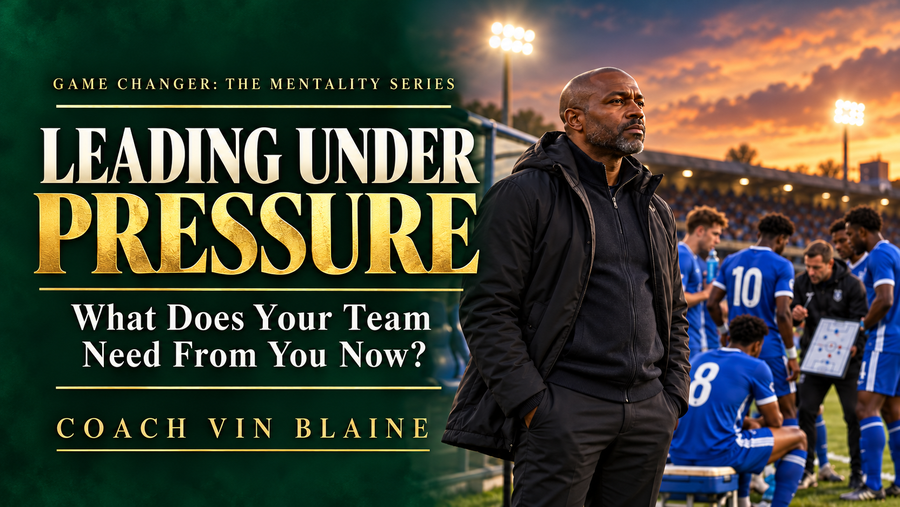
Your team concedes. A player looks toward the touchline. An assistant suggests a change. The crowd is reacting, and you are still trying to understand the turnover.
You feel the frustration. The next decision is what to do with it.
Should you correct the passer, organize the restart, ask for another observation or change the shape? Those are different actions with different purposes.
Leading under pressure begins with a useful question: what does the team need from me now?
Separate the event from your first explanation
A misplaced pass is visible. The reason may be less obvious.
Perhaps the receiver did not adjust. Perhaps the supporting midfielder advanced too early. Perhaps your instruction made the preferred route sound compulsory even when the opponent had closed it.
A quick personal judgment can become a substitution or tactical change before the explanation has been checked.
Give the team its immediate responsibility. Then gather the information needed for the wider correction.
Composure has a purpose
The aim is not to appear emotionless. Coaches can show energy, encouragement and disappointment while remaining clear and respectful.
The question is whether the behavior helps the task.
Arguing about a previous decision while players prepare for a corner may leave the marking problem unattended. Repeating “work harder” may add urgency without repairing the distance between the striker and midfield.
A composed response directs attention toward the next useful action. It does not require a particular personality or speaking style.
Prepare a response before you need it
Identify one familiar trigger and an early sign of your less useful reaction. Perhaps you begin repeating instructions or stop listening to your assistant.
Plan a simple response: stop the running commentary, observe the next relevant sequence and ask for one factual observation. Then select a message connected to the actual problem.
This is a practical coaching routine, not a guarantee that the next match will feel easy. Rehearse it in ordinary practice and staff discussion.
Immediate safety and welfare responsibilities come first. A personal pause must never delay the appropriate response to an apparent injury or dangerous situation.
Make the instruction useful
“Wake up” leaves the players to interpret your frustration.
“When their fullback receives, our winger closes while the midfielder protects the inside pass” identifies a relationship. The detail must fit your game model and the picture in front of you.
Choose the recipient and the moment. A long explanation while a player receives under pressure may arrive too late. An agreed cue or a short unit conversation can be more useful.
Check understanding when there is an opportunity. A clear instruction still needs to be shared by the supporting players.
Use the staff around you
Agree who observes what, how information reaches the lead coach and who speaks to players. Encourage challenge through evidence rather than competing touchline commands.
An assistant can say: “Their winger has received behind our fullback three times, and our midfield cover is late.” That gives the coach a relationship to examine.
A coach working alone can narrow the observation target and note one issue at the next suitable break. The plan should fit the resources available.
Keep tactical changes connected to evidence
Adding an attacker may be justified. Who then protects the next loss?
Pressing higher may create regains. What happens if the first line is bypassed?
An adjustment should include the intended benefit, possible cost and supporting responsibilities. Reassess when the score or opponent changes.
Making a change is not, by itself, evidence of good leadership. The question is whether it addresses the problem with the best information available.
Repair your own mistakes
If you give contradictory instructions or make a personal criticism, acknowledge it specifically. Clarify the task and take appropriate corrective action.
Avoid asking players to reassure you or accept passion as an explanation for harmful behavior. An apology begins the repair; the change that follows gives it credibility.
If a pattern persists, seek appropriate support and examine the environment, workload and responsibilities around it.
One action for your next match
Write down one trigger, one early sign and one useful response. Share the plan with an appropriate colleague if available.
Afterward, review a relevant moment. What did you notice? What information did you use? What did the team need? What will you change next time?
Leadership develops through those specific choices, including matches in which the result remains disappointing.
Introducing Volume 6
Leading Under Pressure: Managing Your Response When Your Team Needs You Most is Volume 6 of Game Changer: The Mentality Series, priced at US$8.00.
The eBook includes ten chapters, six worked matchday situations, four rehearsal activities, a four-week implementation plan and eight editable coaching tools. It covers response routines, communication, tactical decisions, staff coordination, criticism, welfare and repairing your own mistakes.
Notice the moment. Read the need. Carry the next responsibility.