
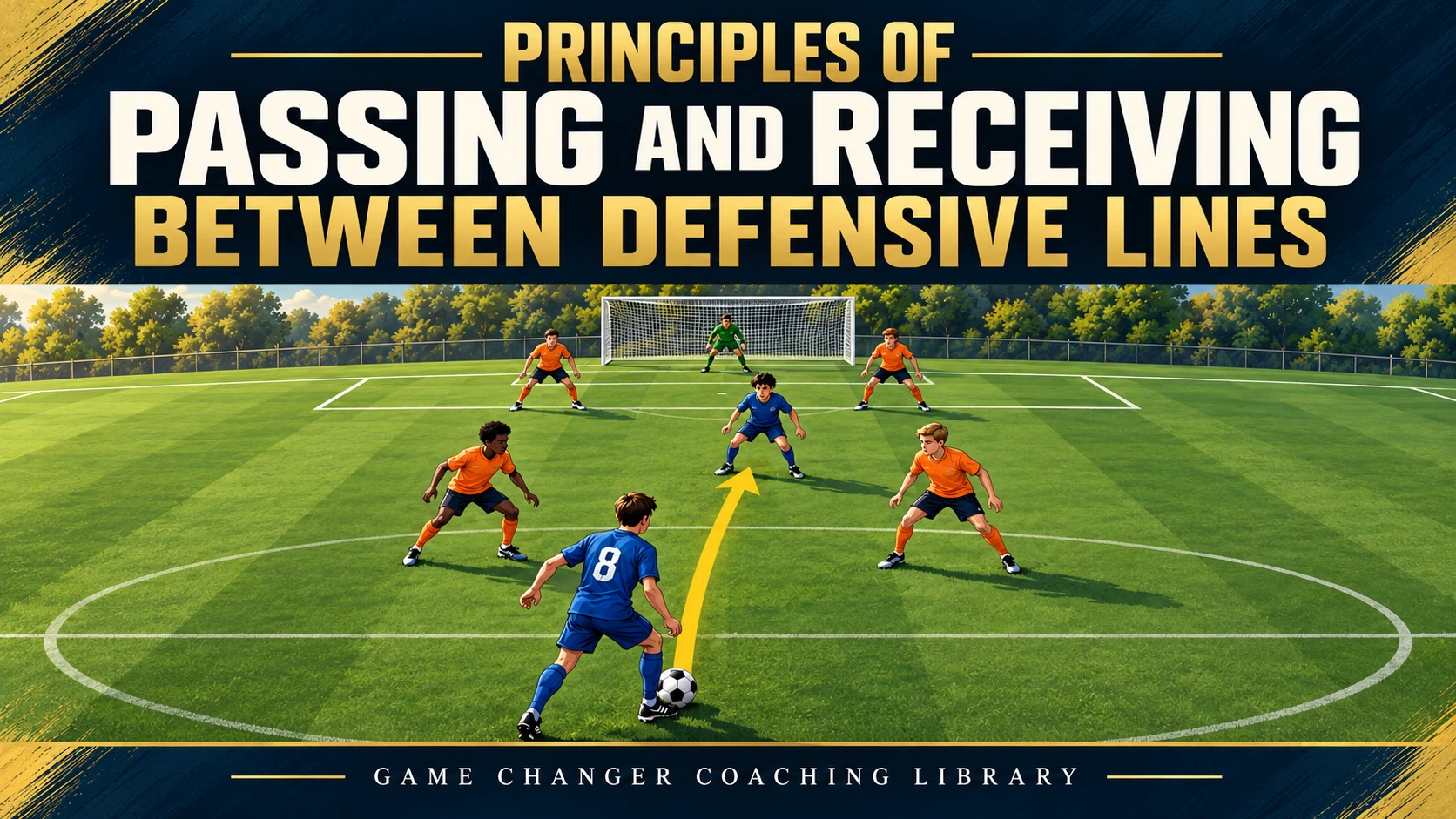
A young midfielder receives behind the first pressing line. The pass looks progressive. But a defender arrives, the receiver cannot turn and the ball is lost. The coach calls for a better first touch. The problem may have started before the pass.
Between-line play connects the passer, receiver and surrounding teammates. A player standing in a pocket is not automatically available. The passing lane must be open, the ball carrier must be able to deliver and the receiver needs a next action.
Start with what the receiver can do Ask players what receiving in a particular space allows. Can they face forward? Set to a teammate? Protect and draw pressure? Combine around a defender? A return pass can preserve an advantage when turning would lose it.
Avoid making every reception a test of whether the player can turn. The game should decide the action.
Before the ball travels Scanning needs a purpose. Help players identify pressure, space and support, then update that picture as the ball moves. Ask, “Where is the defender now?” and “Who can help if you cannot turn?” A glance without useful information does little to improve the next decision.
The passer shares responsibility. A late, underhit or poorly directed pass can make an initially accessible player vulnerable. Coach the timing and destination alongside the receiving action.
Build from the back The goalkeeper and centre-backs need several routes. A pivot beyond the first press can help, but a marked pivot should not become a compulsory target. Carrying, playing wide or using another supporting player may open the next window.
If the pivot drops between centre-backs, ask who connects further forward. Dropping can create one advantage while removing another.
Through midfield Midfield players may have relevant information on every side. Support beneath the receiver gives a pressured player a useful set. A third teammate can arrive facing forward and continue the attack.
Do not crowd every player toward the ball. Depth and width can keep defenders occupied and preserve the space the receiver needs.
Into the attacking third A player in a pocket benefits from complementary threats. A forward threatening behind can discourage a defender from stepping. A wide teammate can offer a different route. A supporting midfielder can recycle when the opening closes.
The coach should observe which opponent is being influenced and what becomes available. Passing totals alone cannot explain that relationship.
Near goal The finishing zone is a functional part of the attacking third. Here the receiver may need to shoot, set, combine or protect in very little space. Teammates should offer different finishing locations rather than all attacking the same point.
A pass into the striker can be successful even when the striker does not shoot. A controlled set to an arriving teammate may create the better opportunity.
Try this at your next session Use a directional 4v4 with two neutral support players. Allow defenders to intercept and vary their pressure. Award normal goals and observe three moments: access before the pass, the receiver's information and the next action. Adjust space and support for the group. Finish without special bonuses and see whether the behaviour remains.
Choose one repeated problem to discuss. Replay it with alternatives available. Ask players what changed rather than telling them to repeat one predetermined solution.
Explore the complete guide Principles of Passing and Receiving Between Defensive Lines: A Practical Guide for Youth Football Coaches is a US$10 eBook by Coach Vin Blaine. It connects build-up, midfield, attacking-third and finishing-zone decisions with six practical activities, four schematic diagrams and eight coaching worksheets.
Game Changer Coaching Library | gamechangercoachinglibrary.com