
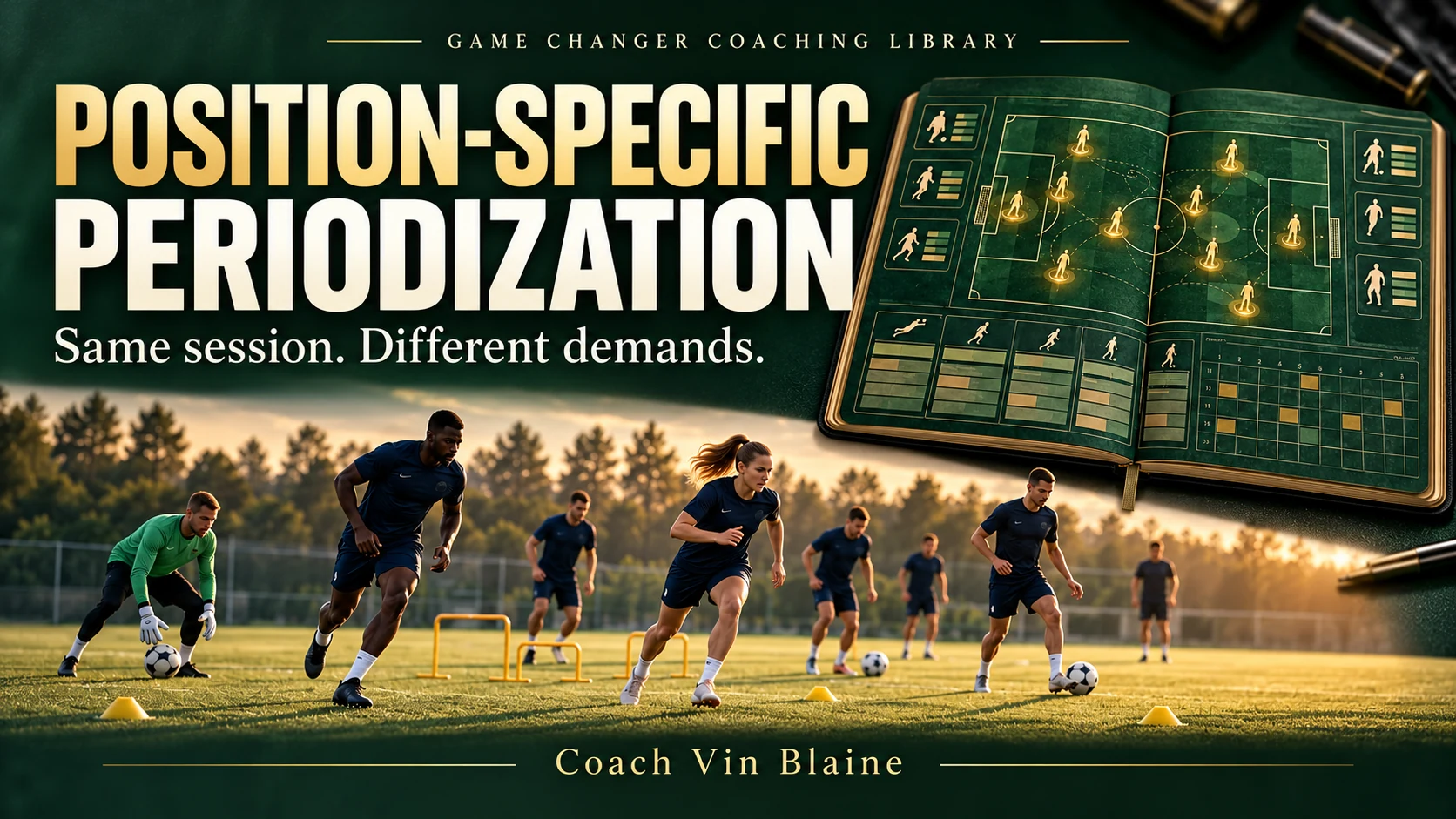
A winger, a centre-back and a goalkeeper leave the same session. All three trained hard. All three were involved. But did all three receive the preparation their next match will require?
The winger may have completed plenty of short combinations without making a longer run behind a defender. The centre-back may have circulated possession all afternoon without defending the space behind the line. The goalkeeper may have faced many shots but never had to support the team against a changing press.
This is the planning question behind position-specific periodization: how do we organise learning, physical exposure and recovery around each player’s role while preparing one connected team?
Start with the role, then consider the position
“Fullback” is a useful label. It is not a complete training plan.
One fullback overlaps a winger and delivers from wide areas. Another moves inside to support the pivot and must recover wide when possession changes. Their starting position may be similar, yet their decisions, relationships and movement patterns differ.
The coach should first describe what the player is asked to do in possession, out of possession and during both transitions. Then identify the information the player needs, the action required and the teammates affected.
For example: when the winger moves inside and the ball carrier can play forward, the fullback may overlap to restore width. But who protects the inside route after a turnover? Without that answer, we have planned the run and left part of the team problem unresolved.
Position work belongs within the team
Separate practice has a purpose. A goalkeeper may need to refine a handling action. A midfielder may need a short period of receiving work. A forward may benefit from a finishing adjustment.
The next question is how that action reconnects with the game. Can the midfielder recognise pressure before receiving? Can the forward time the run against a moving defensive line? Can the goalkeeper choose the right distribution when the opponent screens the preferred receiver?
A useful planning principle is: prepare the player for the role, prepare the role within the unit, and prepare the unit for the team. The individual action becomes valuable through its relationships.
The calendar changes the answer
A normal one-match week can offer room for development, a demanding team exposure and later match preparation. Two matches in a week create a different problem. Travel and a short national-team camp change it again.
A player who completed a full match may need a brief role rehearsal on a day when a ready, unused substitute needs more substantial work. Both can share the same tactical objective while receiving different physical exposure.
That distinction requires information. What did the player actually do? Which role did they play? What happened in training, reserve football, school football or another national-team programme? How have they responded?
An unused substitute is not automatically fresh, and a player with high minutes does not automatically need the same recovery response as every other starter. The plan should account for the person as well as the calendar.
A busy practice can still leave a gap
Small directional games can create many decisions and technical actions. They may also provide limited space for longer runs. A winger can be highly involved yet miss the timing and speed demands of attacking behind. A centre-back may experience repeated pressure without turning to defend depth.
The response should follow the gap. Sometimes a different pitch shape or a larger game provides the missing exposure. Sometimes a selected supplementary task is appropriate. Sometimes the need is technical or tactical rather than physical.
Adding more work without identifying the problem makes the week longer without necessarily making it more useful. First check whether the main programme already supplies what the player needs. A better selected replacement may be more appropriate than another block of extras.
Look beyond total distance
Coaches with tracking technology can connect movement data to video and tactical context. Coaches without it can still record minutes, role actions and player response.
For the goalkeeper, note demanding saves, landings and distribution decisions. For the centre-back, examine depth recoveries, contests and the quality of protection. For wide players, distinguish runs behind from defensive recoveries. For the pivot, observe whether a pressured reception leads to an appropriate next action.
Counts need context. Five forward runs are not automatically better than three. Did the passer have time to release? Did the movement open a teammate’s route? Was the team protected after the action?
Training evaluation should include the situations in which the player correctly chose to hold, support or recycle.
Young players need room to develop
Position preparation should not lock a young player into a role because of current size or speed. Academy players mature at different rates and bring different training histories. A young centre-back can benefit from learning the pivot’s receiving picture; a winger can gain understanding from the fullback’s defensive responsibilities.
Use a clear primary role and selected adjacent-role experiences. Explain what each exposure is intended to develop, and adjust the task to the player’s readiness. The aim is to build understanding and capability that can grow with the player.
Try a one-week audit
Choose three players: a regular starter, a low-minute player and someone learning a different role. For one week, record their actual participation, the key role actions they experience and their response.
Then ask: which important match situations did each player practise? Which were missing? Which actions were repeated unnecessarily? What one change would improve the next week?
That audit is a practical starting point. Position-specific periodization becomes useful when the coach can explain why this player needs this work today, how it connects to the team and what will be reviewed next.
Explore the complete instructional eBook — US$15.00
Position-Specific Periodization: Planning the Right Work for Every Role, Player and Match provides a detailed framework for coaches in elite youth academies, clubs and national programmes.
The guide includes instruction for every positional family, nine opposed practice cards, one-match and congested-week examples, academy and national-team adaptations, complete session plans, monitoring with or without GPS, a worked four-week development block and five reusable planning and review sheets.
Format: Digital PDF eBook | Price: US$15.00