
You can organise a session, keep players active and finish on time, yet still leave the training ground asking: Did that practice help the players develop? What should I do next?
The Blaine Model connects those questions to a purposeful coaching pathway. Created by Vin Blaine, this practical, player-centred framework helps coaches understand their starting point, identify development priorities, design suitable training and review whether their decisions made a difference.
Its six connected stages spell BLAINE. Use them for a session, a four-to-six-week block, a season or your own continuing professional development. The model is cyclical and flexible: a spine for coach thinking, not a cage.
B - Build the Baseline
Effective planning starts with understanding the players and their environment. Look beyond results to consider experience, ability, motivation, maturation and the resources available. A useful baseline helps you choose a priority that fits the group in front of you.
Coach question: “Where are we now, and what does this group actually need?”
L - Learn & Develop the Player
Keep development at the heart of coaching. Consider the whole player: technical, tactical, physical, psychological and social needs. Recognise that players develop differently, and identify a manageable focus that helps each player take a meaningful next step.
Coach question: “What is the player becoming, not just what are they doing today?”
A - Age-Appropriate Training
Match the challenge to the learner. Age matters, but so do experience, maturation, confidence and skill. Adapt your practices so players can engage with meaningful football decisions at a level that stretches them and supports their learning.
Coach question: “Is this session pitched at the right developmental level?”
I - Inquire & Reflect
Make reflection an honest learning habit. Examine what players did, how they responded and what your coaching contributed. Use observations and player feedback to move beyond a general impression of whether the session went well.
Coach question: “What happened, why did it happen, and what does that tell me?”
N - Navigate Next Steps
Turn reflection into purposeful action. Decide what needs to change for the player, the practice or your own development. A small, deliberate step with a clear review point can be more useful than a long list of good intentions.
Coach question: “What is the next small, deliberate step for the coach and the players?”
E - Evaluate & Embed
Check whether your decisions helped over time. Return to the starting point, look for observable progress and decide what to keep, change or stop. Make useful practice repeatable while remaining responsive to the players’ changing needs.
Coach question: “Is this making a measurable difference, and how do we make it stick?”
Turn the model into everyday coaching practice
Understanding the six stages is the beginning. The complete eBook helps you put them to work with practical tools you can copy, adapt and use with your players or in your own coach development.
- Baseline audits and player profiles to establish a clearer starting point.
- Individual development plans and a development matrix to connect player needs with purposeful priorities.
- Age-appropriate session checklists and a practice planner to guide training design.
- Reflection and peer-observation templates to examine learning and coaching behaviour.
- Next-step action plans to turn your review into focused action.
- Evaluation reviews and a keep / change / stop tool to assess progress and embed useful practice.
A worked six-week example shows how the stages connect, while a one-page overview keeps the framework close at hand.
Give your next coaching decision a clearer purpose
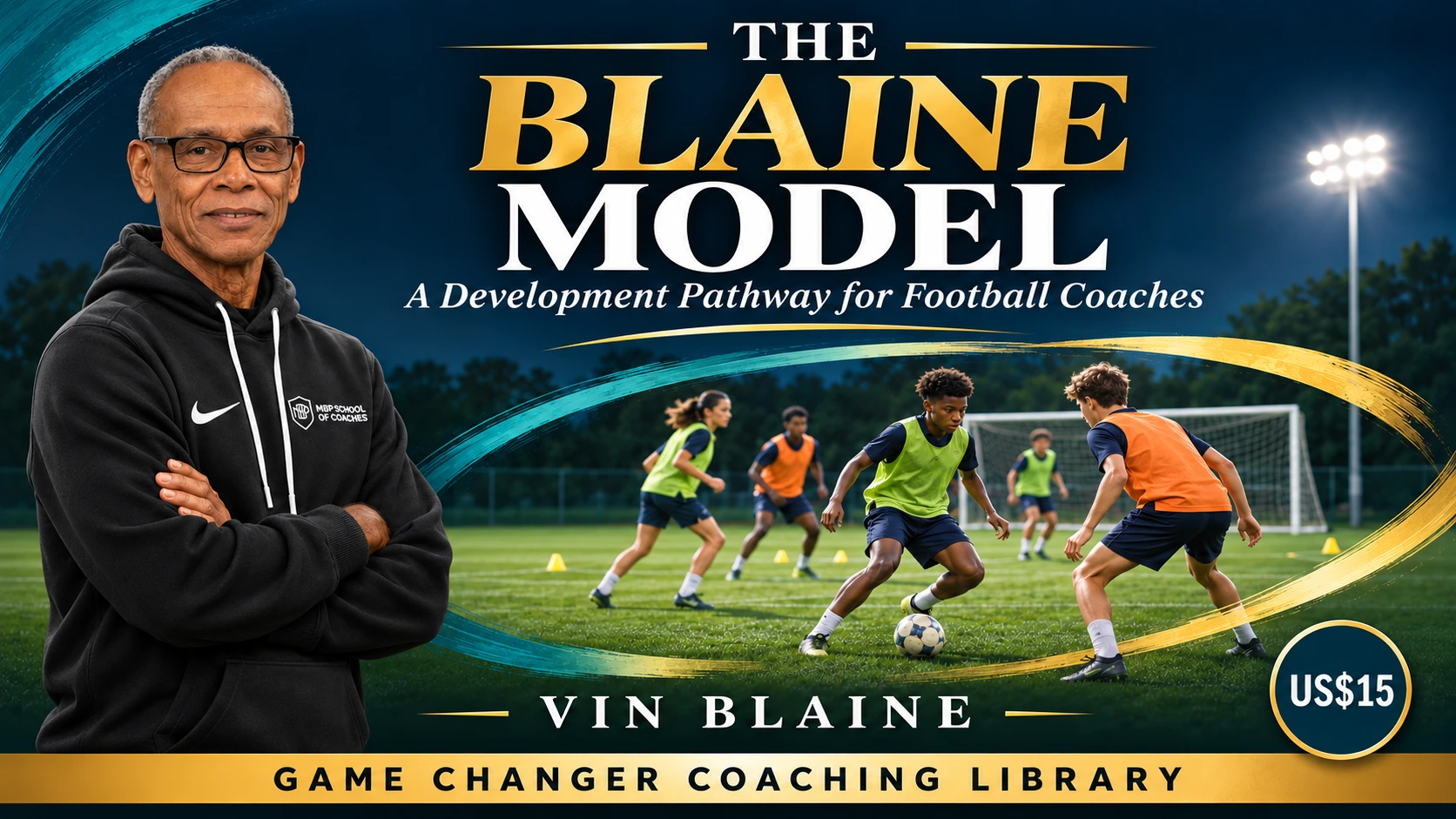
Whether you coach a youth team, work in an academy or support other coaches, The Blaine Model: A Development Pathway for Football Coaches gives you a practical structure for connecting planning, player development and your own learning.
Plan with purpose. Reflect with honesty. Act with focus. Evaluate with evidence.
Get the complete 26-page eBook by Vin Blaine for US$15. Includes the six-stage framework, practical coaching templates and a worked example in a downloadable PDF.