
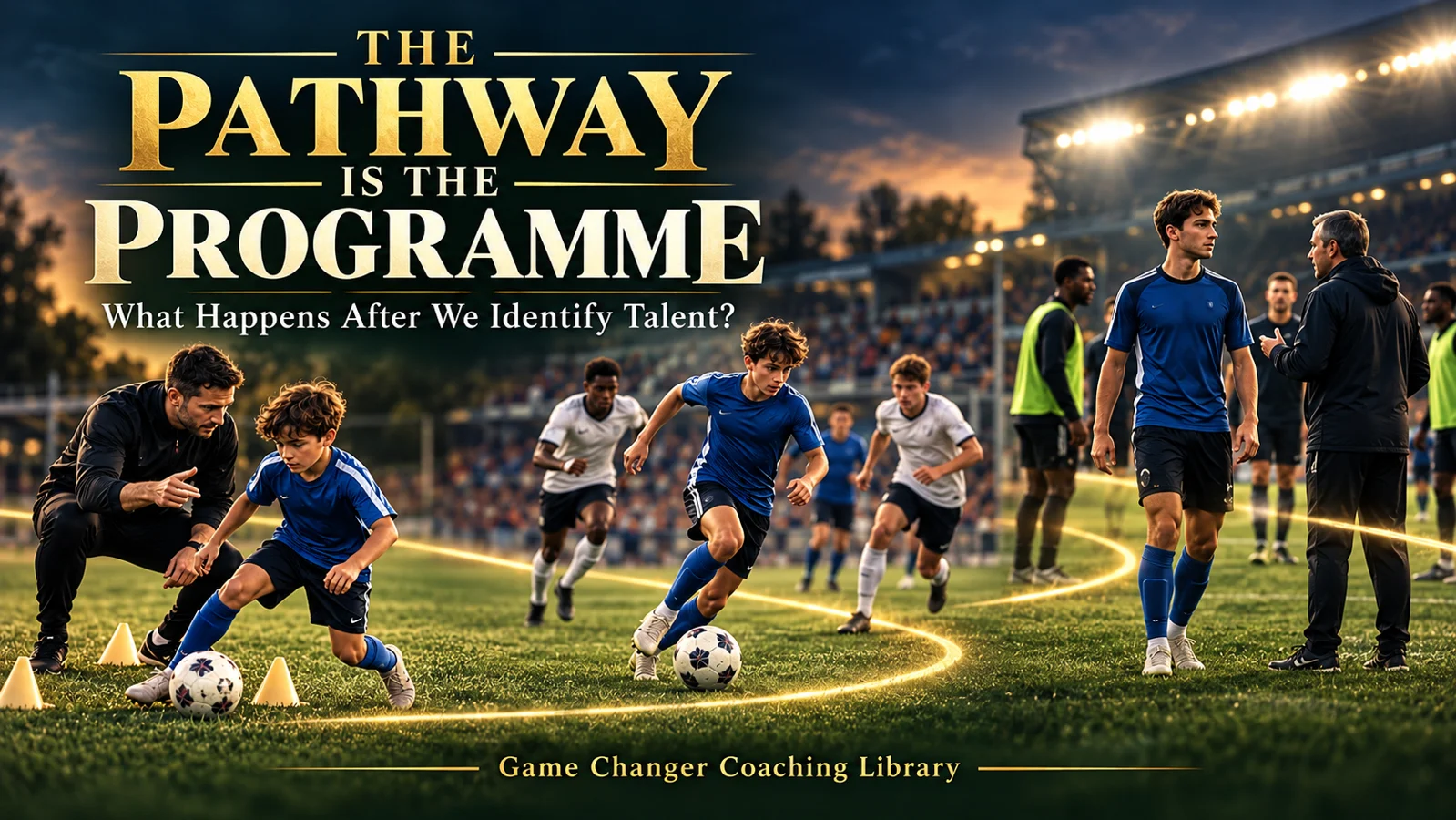
A young player earns a place in a regional squad. The family celebrates. The coach says, “This one has a future.” Six months later, the player attends occasional camps, trains well, and spends most match weekends on a bench. No one has explained which football problem they are working on, who will help them get minutes, or what happens when the season ends.
The player was identified. But where was the development programme?
We sometimes speak about the talent pathway as if selection automatically starts a journey. It does not. A pathway only becomes real when the player receives the training, competition, guidance and opportunities needed to move forward. FIFA describes talent development in terms of identification, training and playing opportunities. Its analysis also warns that gaps in age-group competition and routes into senior football can interrupt that journey. [1,2]
For youth coaches, the most useful question after selection is simple: What will this player experience next?
The badge cannot replace the minutes
A call-up can expose a young footballer to stronger peers and a higher standard. It can also become a substitute for actual development if the player trains with an elite squad but rarely plays. A prestigious environment is valuable when it gives the player meaningful work and an appropriate game programme.
Consider two U17 midfielders. One trains twice a week with a senior side and plays a full competitive youth match most weekends. The other trains with the senior side, travels as an unused substitute, and loses their youth-team game. Neither arrangement is automatically right, but the second demands a clear explanation: What learning is replacing the lost match? Where will this player test decisions under pressure?
Do not count minutes alone. Ask what happened in them. Did the player have a role? Did the opponent create a real challenge? Did the player have to solve the game problem they had been practising? A ten-minute senior appearance can offer a valuable reference point; it cannot be the entire playing programme.
Training quality has to connect to a next challenge
A player may train often without receiving the experience they need. “Improve decision-making” is too broad to guide a session. “Scan before receiving between the lines and adjust your angle when the defender closes the forward route” gives player and coach a situation to practise and observe.
A coach can turn one development question into three linked experiences:
- Training: Design a game in which opponents can close the passing lane and the player must choose a new receiving position.
- Competition: Ensure the player has a suitable match role in which that situation can arise naturally.
- Review: Use a few clips to discuss what the player saw, chose and did—not just whether the team won.
If the player never encounters the problem in training, the objective remains a sentence in a document. If the player trains it but never competes, the coach does not know whether the learning carries into a match.
A move to a bigger club is another beginning
A club change can bring better coaching, facilities and competition. It can also create longer travel, a smaller role and fewer games. Before celebrating the badge, ask the receiving club what the player's actual training and match opportunities will be.
Agree a first-month check. Has the player understood their role? Are the promised sessions and games happening? How is school or travel affected? Does the new coach know the player's strengths and current learning objective? A handover conversation can prevent the player from starting again with no useful context.
If the plan is not working, change it. Returning to an environment with meaningful games is sometimes a sensible development decision, not a failure.
The senior door needs someone to hold it open
The step into senior football brings different tempo, physical demands and expectations. A youth player may be ready to observe senior training, then join part of a session, then take a regular training role before earning match minutes. Another may be ready to compete sooner. The coach should describe the football and welfare reasons for each step rather than apply a fixed age timetable.
A transition also needs a named person to coordinate it. Who tells the youth coach what the senior team wants? Who tells the senior coach what the player can already do? Who checks that the player still has games when first-team minutes do not arrive? FIFA's account of Mamelodi Sundowns' transition work illustrates the value of a bridge between youth and first-team environments; UEFA has likewise highlighted the transition-coach function and individual development plans. [3,4]
The senior coach has to select a team. The youth coach can make that decision better informed, and help arrange a suitable alternative if the player is not yet selected.
Five questions for your next pathway review
Choose one player you have identified and ask:
- What are two strengths we can describe through actual game actions?
- What football problem is the player working on now, and where is it trained?
- What meaningful matches and roles did the player have in the last six weeks?
- Who owns the next handover and when will we check whether the move works?
- If senior minutes are unavailable, where is the player's next suitable game?
If you cannot answer a question, you have found work for the programme—not evidence that the player lacks commitment.
The responsibility after selection
A young player is more than a selection decision. Their development is shaped by the coach who designs Tuesday's practice, the club that gives them Saturday's role, the person who supports a move, and the senior coach who offers an honest opportunity. Each has an influence; none can guarantee a professional career.
The strongest pathway is one the player can actually travel: with good training, real games, useful feedback, support during change and an open door for late developers. Identify the talent. Build the experience. Protect the opportunity. Review the next step.
Continue with the eBook: The Pathway Is the Programme: From Talent Identification to Senior Football Opportunities is a US$15 instructional guide for youth coaches. It includes detailed decisions on training quality, competitive minutes, playing up, club moves and senior exposure; three worked player journeys; six practice designs; a season-long operating rhythm; and seven reusable worksheets. Available now for US$15.00.
Sources
- [1] FIFA Training Centre, “High Performance.” https://www.fifatrainingcentre.com/en/environment/high-performance.php
- [2] FIFA Training Centre, “Play the talent.” https://www.fifatrainingcentre.com/en/environment/talent-development/talent-development/play-the-talent.php
- [3] FIFA Training Centre, “David Notoane on transitioning talents.” https://www.fifatrainingcentre.com/en/environment/interviews/mamelodi-sundowns-and-the-transition-phase/david-notoane.php
- [4] UEFA, “Coaching insights from the 2026 club competition finals.” https://www.uefa.com/news-media/news/02a6-20d1afe2ba1d-6052cde75702-1000--coaching-insights-from-the-2026-club-competition-finals/