
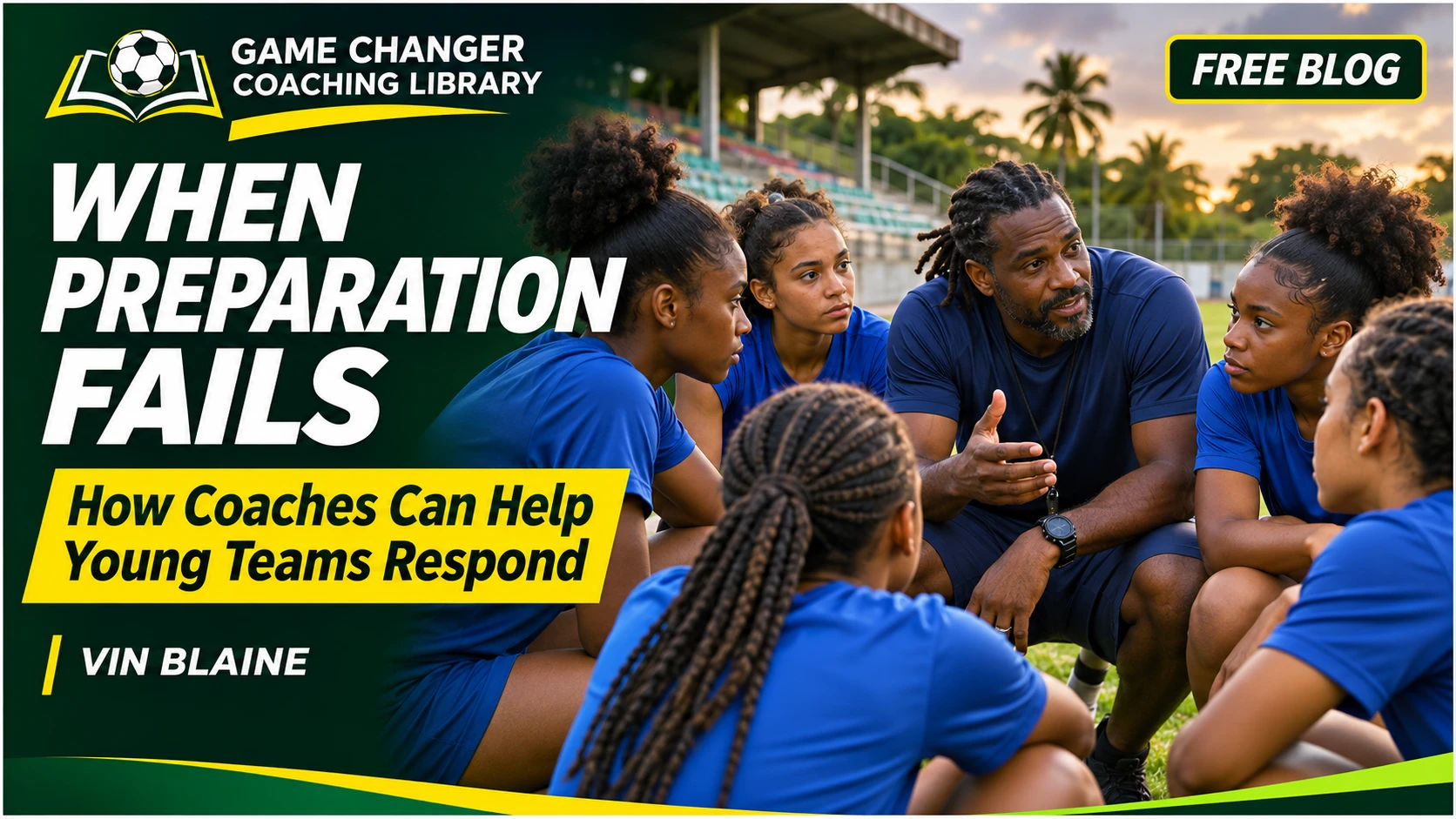
How can coaches handle a tournament when their players arrive without the preparation they need to compete?
For youth coaches in academies, clubs and national programmes, this question reaches beyond formations and team selection. It concerns the responsibility to lead young people through a situation they did not create, while making sure the adults responsible for preparation remain accountable.
Consider this scenario. Administrative negligence leaves a team with one camp before travelling and another after arriving at the tournament. The players enter competition lacking fitness, shared understanding and adequate match preparation. Their opponents have had more preparation time, practice games and stronger squads.
Across the tournament, the team concedes 27 goals and scores two. A heavy defeat in the second game leaves the coaches facing an immediate challenge: how do they prepare the players mentally and emotionally to compete again?
Yet the team improves as the tournament progresses. It eventually wins its playoff against an opponent it has never beaten before.
Both parts of that story matter. The preparation was inadequate. The players still found a way to improve and achieve something meaningful.
For coaches facing similar circumstances, the task is to help the team respond now and secure changes that give the next group a fairer opportunity.
Start with an honest assessment
A tournament exposes what a team has had the opportunity to develop. Players who have barely trained together cannot reasonably be expected to show the coordination of a squad that has rehearsed its roles and tested them in practice matches.
However, preparation and squad quality are different problems. More camps may improve organisation without removing a technical gap between opponents. Coaches need to understand both.
Before adding more instructions, establish what is actually breaking down. Are players unsure when to press? Are the distances between units too large? Does the team lose possession because support arrives late? Are players struggling to repeat efforts, or running unnecessarily because their positioning is poor?
These questions lead to more useful decisions than describing the group as lacking character.
Keep two records: the preparation that was available and the football behaviours observed. This helps explain the context while preserving an honest assessment of performance.
Adapt the game plan to the players available
When preparation time is short, coaches must decide what can realistically become clearer before the next match.
Trying to introduce an elaborate system can overwhelm a group already uncertain of its responsibilities. Select a small number of connected priorities and practise them in situations players will recognise.
For example:
- Protect central areas and move across together as the ball travels.
- Agree when the nearest player presses and how teammates provide cover.
- On regaining possession, offer an achievable forward pass and a supporting option.
Explain these priorities through positions, demonstrations and short passages of play. Check that players can show the response, rather than simply repeat the instruction.
The defensive line must also respond to pressure on the ball. If an opponent has time to look up and pass behind, the team needs a shared response to that threat. Asking defenders to hold an aggressive position without pressure ahead of them can expose an under-prepared group repeatedly.
Preserve an attacking route, too. A team that only clears the ball may face another attack immediately. Identify where possession can be retained, who can provide an outlet and how others will support.
Use the remaining time carefully
Limited preparation often tempts coaches to make every available session longer and harder. That urgency can turn into another burden for players.
The camp after arrival should have a clear purpose. It offers time to establish roles, rehearse essential situations, settle into the environment and assess readiness. Its value depends on what players understand and can apply afterwards.
Between matches, coordinate with the relevant staff about player availability and workload. Consider minutes played, travel, reported fatigue and individual needs when deciding who does what.
A short walkthrough may resolve uncertainty about defensive positioning. A brief practice may clarify what happens after regaining possession. An individual conversation may help a player understand a role that a long team meeting has failed to explain.
Additional running should never become punishment for a scoreline.
After a heavy defeat, manage your own response first
The coach may feel angry, embarrassed or exposed. Those feelings are understandable, particularly when preparation failures were outside the coach’s control. They still need to be managed before addressing the players.
Young players will notice tone, facial expression and how staff speak to one another. A coach who appears to have given up makes it harder for the group to believe that another response is possible.
The FA’s guidance on helping young players cope with disappointment emphasises reassurance, support and a mature response from coaches after defeat.
Immediately after the match, keep the message brief and honest. A coach could say:
“That was a difficult result, and we are disappointed. We will review what happened when we are ready to learn from it. For now, look after yourselves and one another. Before the next game, we will make our jobs clearer.”
Avoid demanding an emotional response on command. Some players will want to speak; others will need time. Check individually on those who appear especially distressed or who feel personally responsible.
Rebuild belief through evidence
Telling players to forget the result rarely gives them a way forward. They remember the goals, the mistakes and how exposed they felt.
Help them understand what happened without turning the review into a replay of their worst moments. Select a few examples that explain a recurring problem, then show what a better response would look like. Include moments when the team did execute its task.
Ask specific questions:
- What made it difficult to support the player defending the ball?
- When did we stay connected successfully?
- What helped us keep possession after winning it back?
FIFA’s guidance on coaching communication supports using clear instruction when players need direction and questions when they are ready to reflect and contribute.
Use both approaches. Give a direct cue where uncertainty is high, then ask players to demonstrate or explain their decision.
Confidence becomes more credible when a player can identify something that worked and knows how to repeat it.
Make mental preparation part of the football plan
After the heavy second-game defeat, emotional preparation becomes central to getting the team ready to compete again. It still needs a practical connection to what happens on the pitch.
Fear of conceding can make a defender retreat too early. Fear of making another mistake can make a midfielder hide from the ball. Frustration can lead a forward to press alone and leave the team stretched.
Help players recognise these responses and give them a manageable next action.
A defender might focus on checking a teammate’s position and communicating before the next attack. A midfielder might commit to scanning and offering a passing angle. A forward might wait for the agreed pressing cue.
Rehearse a response to conceding: stop blame, reconnect with teammates, regain positions and return to the agreed plan. Players should know who will communicate and what information is useful.
The aim is to help them act effectively while disappointed or nervous. They do not have to feel fearless before they can contribute.
Choose progress measures players can influence
The result remains important. During a difficult tournament, coaches also need evidence that their adjustments are helping.
Choose a few observable behaviours rather than a long list of targets. These might include the team shifting together, recovering its shape after losing possession, providing support after a regain or responding constructively after an error.
Be precise with feedback. “Our midfield moved across early and closed the central pass” tells players what improved. “Much better attitude” gives them less information about what to repeat.
Check progress against the match context. Fewer goals conceded against a different opponent does not, by itself, prove every defensive problem has been solved. Look at the quality of chances allowed, the decisions players made and whether the intended behaviours appeared more consistently.
This makes improvement visible without exaggerating it.
Give the staff a shared message
Players can become more confused when every staff member offers a different solution.
Before the next team meeting, agree on the immediate priorities, the language used on the touchline and who will deliver key information. Decide who will check in with players individually and how concerns will be shared.
Staff should challenge each other privately and constructively. During the match, players need clear information they can use.
The head coach also needs support. A short staff conversation can identify what is working, what needs changing and whether frustration is affecting decisions. Coaches should not have to manage the group’s emotions while having no space to process their own.
Celebrate the playoff win fully
Beating an opponent the team has never beaten before deserves recognition. For players who have endured heavy defeats, it can become a powerful memory of persistence and collective improvement.
Discuss what contributed to that performance. Was the team more connected? Were roles clearer? Did players communicate earlier or recover better after mistakes?
Listen to their accounts. Their answers may reveal which messages and adjustments they found most useful.
However, the win does not establish that inadequate preparation was acceptable. Nor does it prove that hardship automatically develops resilience. The team achieved something despite the circumstances, and that distinction must survive the celebrations.
Give players credit for their response while continuing to examine what the programme should have provided.
Turn the tournament review into decisions
Once the tournament ends, the organisation needs more than a general request to prepare better.
Record the original preparation plan, what actually happened, the decisions that reduced it and the consequences observed. Where administrative negligence caused the shortfall, establish the specific actions or omissions and who held responsibility.
The review should also examine coaching choices, selection and player development. Accountability becomes stronger when everyone’s responsibilities are visible.
Set out the next preparation programme with named owners, approval deadlines, resources and review dates. Include appropriately matched practice games, time to assess them and opportunities to adjust before departure.
An academy may need coordination between age-group coaches and tournament organisers. A club may need earlier squad confirmation and protected training dates. A national programme may need agreed player-release arrangements, camps and decisions well before travel.
Where adequate preparation cannot be secured, raise that issue early enough for decision-makers to reconsider the plan.
The responsibility that remains
A coach cannot recreate lost preparation time during a tournament. The coach can still give players clearer tasks, protect their dignity and help them find a credible reason to compete again.
The team that conceded 27 goals and scored two should have its full story told: the preparation failures, the difficult results, the improvement and the playoff victory.
The players earned recognition for how they responded. The adults responsible for the programme must now give the next group a better starting point.
Reflection for coaches: If your team had to play again tomorrow after a heavy defeat, what would you simplify, what would you say, and what would you need to understand from the players before deciding?