
You have a question at a coaching workshop. The discussion is moving quickly, and several participants seem familiar with every tactical term.
You decide not to ask.
Later, you leave with the same uncertainty you brought into the room. The opportunity to learn has been lost because you were trying to avoid looking like someone who needed to learn.
For a developing coach, that is a useful moment to examine. You do not have to present yourself as a finished expert to make a responsible contribution to football.
Describe the uncertainty
“I do not belong here” feels like a conclusion. Often, it combines a specific difficulty with an assumption about what that difficulty means.
Perhaps you could not explain a practice rule. Perhaps another coach used unfamiliar terminology. Perhaps your session did not produce the learning you intended.
Each deserves attention. None, by itself, explains your whole value or future as a coach.
Write the event plainly. What happened? What do you know? What are you assuming? What would help you understand it more accurately?
A clear description can reveal a learning task that a personal label obscures.
Prepare for the players
Self-doubt can lead coaches to copy complex practices because complexity appears to demonstrate expertise.
Begin elsewhere: what football problem do your players need to solve?
Choose a suitable activity, prepare the organisation and decide what you will observe. Rehearse the explanation and anticipate a couple of adjustments.
If the practice does not work, examine the design and the players' information. Adapting responsibly is part of coaching. It does not automatically expose you as inadequate.
Preparation should free your attention for the players, rather than keep it fixed on how knowledgeable you appear.
Ask the useful question
At a course, ask for the example you need: “Could you show that in a match situation?” or “Which player relationship would you observe first?”
You can contribute your own experience without making a universal claim: “With my group, that rule caused players to force the pass. What might explain the difference?”
The purpose is to understand the football and improve your decisions. You do not need to win a comparison with the most experienced person in the room.
Learn from experienced coaches without copying their setting
Describe who you coach, what you observed and what you have tried. Ask about the reasoning behind an approach.
Then examine the conditions. A professional team may have more training time, different technical capabilities and specialist support. A principle can be useful while the original exercise needs substantial adaptation.
Speak honestly about your role and experience. A clear question from a modest environment can produce a worthwhile professional conversation.
Make feedback specific
Ask an observer to watch one aspect of your work. Did the intervention help players recognize the pressure? Did they understand the restart? Did the practice permit the decision you intended?
During review, distinguish the observation from your interpretation. “The restart explanation was unclear” identifies something to improve. “They think I should quit” is an additional claim that needs evidence.
Clarify the example, select an action and arrange another opportunity. Development needs more than reassurance, but correction need not become a verdict on your identity.
Belonging includes boundaries
You should be honest about gaps that affect safe or appropriate delivery. Seek assistance when a task lies outside your competence or authorization.
Equally, do not treat exclusion, discrimination or humiliating feedback as problems you must solve by becoming more confident. Learning environments have responsibilities too. Use suitable support and organisational routes when needed.
If distress persists or disrupts daily functioning, appropriate qualified support can sit alongside professional mentoring. A mentor should not be assumed to provide therapy.
One action for this week
Choose a single capability you want to improve. Define it through what the players need, prepare one opportunity and request specific feedback.
Afterward, record what changed and what remains uncertain. Then choose the next step.
You may still feel nervous. You can also be communicating more clearly, observing more accurately and contributing more usefully. Notice those actions as part of the evidence.
Introducing Volume 5
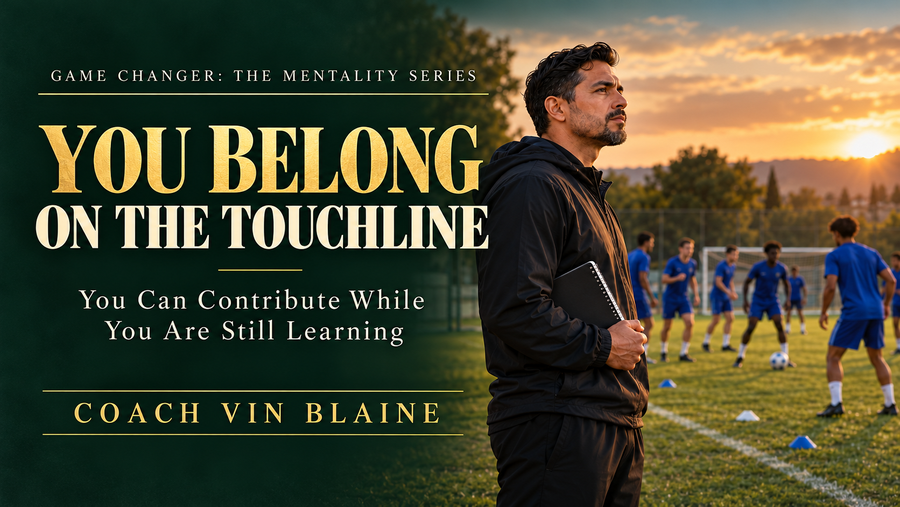
You Belong on the Touchline: Navigating Self-Doubt and Growing as a Football Coach is Volume 5 of Game Changer: The Mentality Series, priced at US$8.00.
The eBook includes ten chapters, six worked situations, four practical development activities, a 30-day plan and eight editable reflection tools. It addresses courses, feedback, mentoring, difficult sessions and professional conversations through practical coaching decisions.
Take your place as a coach who prepares, contributes, seeks support and keeps learning.